Some Woman, National Theatre
Saturday 17th October 2026
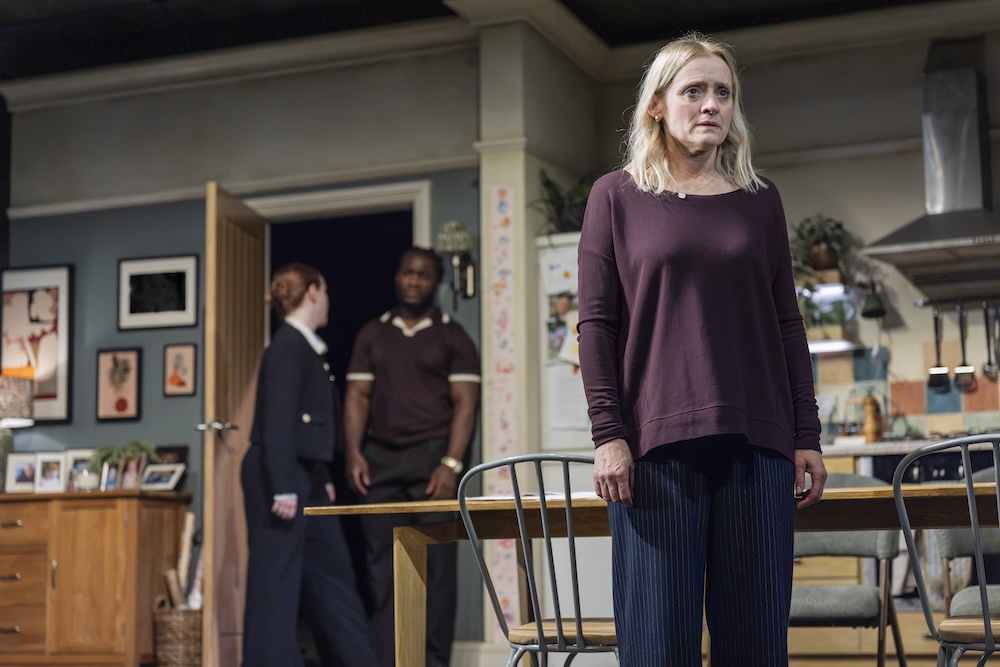
Older women, even middle-class women, are living with unbearable stress. Don’t believe me? Well, look around you. The stress of living up to slogans about “having it all”; the stress of divorce and selling the family home; the stress of looking after the kids; the stress of also looking after older relatives; the stress of finding a good job when you’ve taken time out to have children. Not to mention housework, the menopause and flexible working from home. Okay, now you’re in the world of Helen Edmundson’s new play, Some Woman, at the National Theatre, and guess what, it’s our world too. A world of invisible older women.
Anne-Marie Duff stars as Julie, a middle-aged, middle-class divorcée who parted company with her cheating husband Richard some 11 years ago, and has brought up their two daughters, the ambitious girl-boss Kate and the younger stay-at-home Ginny, who has mental health problems. One day, on the local railway station platform, a young boy comes up to her and calls her “a fucking bitch”. Out of the blue. Instead of ignoring him, she reacts angrily, and precipitates a chain of events that results in her, not him, being interviewed and charged by the police. What happens next is a kind of nightmarish escalation that feels more like a television thriller than a stage play.
Anyway, it’s a powerful portrayal of the stresses of being an older woman today. Duff, on stage for the entire 110 minutes of the drama, turns in an excellent, highly emotional performance as Julie, who has to cope with selling the family home, a boss who thinks he can contact her at all hours, one antagonistic daughter and another needy one, an ex-husband who is unsympathetic — and a school and legal system which, in this version of reality, is loaded against her. To be fair, the first half of the show is a compelling and convincing thriller, which owes something both to the radical feminism of Sarah Daniels’s Masterpieces and the social observation of Vivienne Franzmann’s Mogadishu.
Gradually, however, the plot begins to seem increasingly far-fetched both in its everyday detail, legal and otherwise, and in its exaggeratedly polemical depiction of toxic masculinity. At one point, near the end, this is so unbalanced as to be almost comical. Yet, at the same time, Some Woman does represent, if not exactly explore, a lot of social issues in a strongly emotional way. The scene where Julie confronts Richard about his lying and cheating, or the implications for her job of a criminal conviction, or the assumption that it is she who will care even for their grow-up kids, are all written with deep empathy for her. Yet, simultaneously, it’s hard to shake off the feeling that this is a polemic in which ideas take precedence over people.
As the programme notes make clear, the play is an exasperated critique of, in Julie’s words, the notion that women “can have it all”. Instead of the ambitious dream of female liberation and empowerment, she finds, like many other women, that this is “an impossible bloody con”. As suicidal thoughts intrude, she feels increasingly ashamed of herself; in despair, she says, “There’s no joy.” The bleakness of her situation underlines this picture of the fragility of middle-class life, where many mature women find their heads in a pressure cooker of unrelieved stress. This is real — just look around you.
The trouble with this is that every progressive person can agree with Edmundson’s portrayal of Julie, and Duff’s performance is detailed and gut-wrenching. There’s also a recognizable touch of Henrik Ibsen’s An Enemy of the People in the central character’s determination to seek justice at the expense of family, and the play ends on a fierce declamatory note which is rhetorical, frankly manipulative and a narrative cop-out. On the other hand, it is also right that both Edmundson and Duff don’t make Julie too likeable a character, and she does after all give voice to feelings that are all-too-common across the West.
As well as being concerned with women, the play — rather more obliquely — is also about class. Edmundson’s Julie is an example of middle-class fears of the violence of the urban poor. As the story develops, the resentment of disadvantaged victims, and their desire to exploit the woke-ness of middle-class professionals, slowly climbs into view. However implausible, the transformation of the little boy from foul-mouthed perpetrator, an Adolescence-style toxic male, into a traumatised child, carries a strong emotional charge. In a very heavy encounter, his upbringing is shown to be the cause of his behaviour, and the sense of a dangerous lower-class of resentful men is clearly apparent.
Blanche McIntyre’s well-focused production is meticulously designed by Robert Jones, on a set that transforms smoothly and choreographically between Julie’s naturalistic kitchen and the more austerely cold environments of various state institutions. Clearly, Duff dominates the show, giving a sincere and gripping reading of Julie’s life unravelling, a spiral that leads to the realisation that all the good things she’s done are now unappreciated, and only trauma remains. The other actors also make an impression: Geoffrey Streatfeild’s Richard is suitably unempathetic, Hannah Onslow’s Kate is sharply antagonistic and, by contrast, Tobi King-Bakare is charming and amusing as her husband, while Grace Doherty’s Ginny has a frail but intense presence. This is a solid naturalistic drama that articulates an important social issue, but it’s a bit too didactic for my liking.
This review first appeared on The Arts Desk
• Some Woman is at the National Theatre until 21 November.