Electra/Persona, National Theatre
Thursday 3rd September 2026
“What if?” is a really provocative question. What if Greek tragedy is really about mental illness? What if Clytemnestra’s killing of her husband Agamemnon is not vengeance, but psychosis? What if her daughter Electra is terminally depressed? What if Electra’s sister Chrysothemis is on the spectrum? Then, more practically, what if you read Sophocles’s Electra (circa 420–414BCE) through the lens of Ingmar Bergman’s Persona (1966)? Well, now we are right inside the world of Benedict Andrews’s new mash up, Electra/Persona, premiering at the National Theatre and starring Cate Blanchett and Nina Hoss (who at the start of the show ask an audience member to toss a coin to decide which of the two will play Electra/Elisabeth or Clytemnestra/Alma).
Bergman’s film provides the plot: during a performance of Electra, Elisabeth Vogler, a celebrated stage actor, suddenly becomes mute. She falls completely silent. Breakdown. Committed to a psychiatric hospital, her doctor has a progressive and radical idea: she gives her patient, and her supervising nurse Alma, the use of her summer beach house. Isolated, the two women develop an ambiguous relationship in which their personas are shown as unstable, and their identities fluid. Although Alma does most of the talking, Elisabeth is equally expressive in her determined silence. In the film’s most notable sequence, the faces of the two women are blended together.
In two hours of stage time, Andrews similarly brings together Sophocles and Bergman, first by staging a couple of episodes from an overtly contemporary production of the Greek tragedy, which at a crucial moment falls apart, and then by staging a likewise contemporary version of the film, using a hand-held camera and projecting close ups of Elisabeth and Alma’s faces onto a large screen. This gives sharp focus to the theme of dual identity, suggesting parallels between Electra/Elisabeth and Clytemnestra/Alma, and expands the relationships of mother and daughter, carer and patient, in both stories.
The result is profound meditation on the relationship between role and personality, which highlights the existential sense of uncertainty and contingency. This can best be appreciated through the implicit questions that the play asks: how does playing a part on stage affect the actor? What is the difference between an actor’s role and the social masks we all adopt? How stable is our sense of self? Can our inner identity be changed by contact with a more powerful individual? Is a celebrity more powerful even when they are troubled? Can silence be as expressive as constant talk?
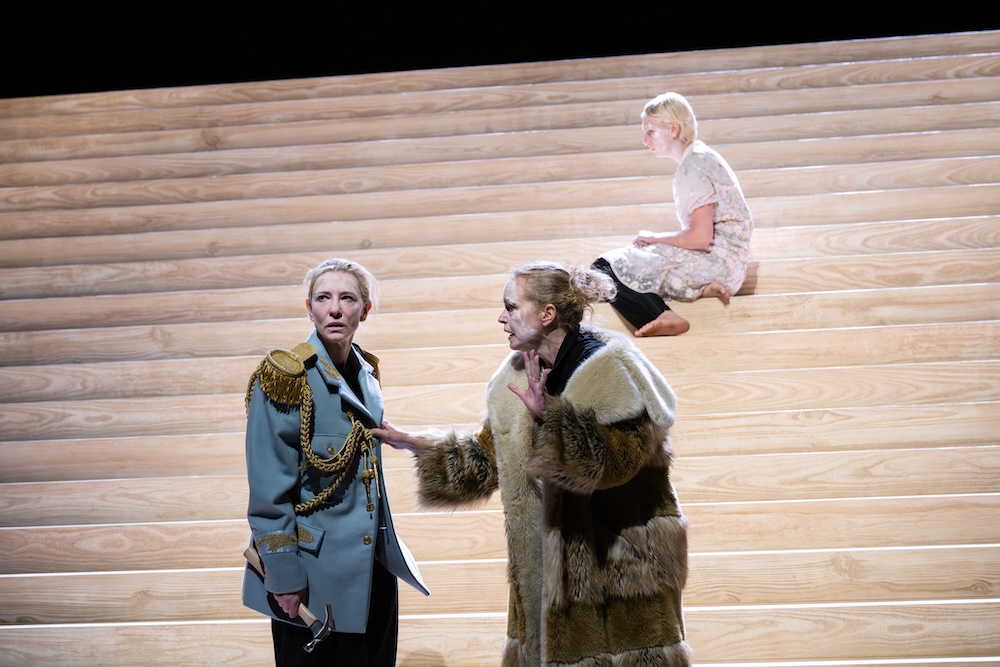
The experience of watching this show is clearly dominated by the two main actors: on the night I went, Blanchett played Electra/Elisabeth and Hoss Clytemnestra/Alma. In the first section, Electra, both actors wear contemporary black clothing and whiten their faces with chalk, emphasising the artificiality of this adaptation of Sophocles, with Blanchett’s furious Electra tipping clothes that she’s found in bin bags over the steep steps of Magda Willi’s staircase stage, then wearing her mother’s fur coat as a joke and her murdered father’s uniform as an act of rebellion. Meanwhile, her sister (Ella Lily Hyland) puts on the dead Iphigenia’s virginal clothes. Yes, it’s all about heightened emotions and assuming roles.
Wielding a hammer and seething with rage, Blanchett looks dangerous, but despite her threatening verbals, and her taking on the character of her avenging brother Orestes, Hoss’s Clytemnestra reacts relatively calmly. She has a strong mother’s control; a sense of perspective on her daughter that is coolly ironic, and occasionally humorous. The most visually dramatic moment is the killing of Aegisthus (Patrick Robinson), her lover, which is done with repeated spitting of blood over his face and body. In Persona, Hoss’s wonderfully garrulous Alma contrasts sharply with Blanchett’s mute Elisabeth, whose face, always expressive, always loud, always intense, dominates the huge screen above the stage. Once again, the surrogate maternal persona, as well as the angry child persona, is shared by both women.
Perhaps the most radical material in both stories concerns motherhood. Having killed her husband, Clytemnestra is so grounded in her feelings of justice and closure, her success in avenging the death of one daughter, Iphigenia, that her other two daughters scarcely register. Sure, Electra is passionately angry, but to her mother she is still a noisy child. And powerless. The one she might worry about is her son Orestes. But he’s absent. In the Bergman story, Elisabeth is deeply disinterested in her child: although she knows the social pressures that mothers are under to be maternal, yet she’s also clear that she doesn’t have those feelings. She resents her son. He’s a burden.
The effect of Andrews’s writing and direction is deeply contradictory: this is both cerebral and emotional; compelling and distancing; fascinating and a bit banal. The faces projected on the screen are both expressive and expressionless. The masks the characters put on are equally revealing and concealing. We are all acting, yet also being; in the moment, if likewise absent. As we watch the actors demonstrate their craft on stage, their electricity and sheer brilliance perhaps distracts from the feeling that there is something both pointless as well as gripping in the exercise of creating a stage version of a profoundly resonant film. What if we just stick with Bergman’s original?
This review first appeared on The Theatre Times