Catarina and the Beauty of Killing Fascists, National Theatre
Monday 21st September 2026
Theatre can be a joy. This we know. But what if it’s also a real trial? Whatever you think of the politics of Portuguese writer and director Tiego Rodrigues’s provocatively titled Catarina and the Beauty of Killing Fascists, now visiting the National Theatre for one week only and performed in Portuguese with surtitles, it certainly tests your mental and physical stamina. So while it’s great that this flagship venue has brought an Avignon Festival hit to London, the experience of watching the show is a deliberately fraught one. An endurance test.
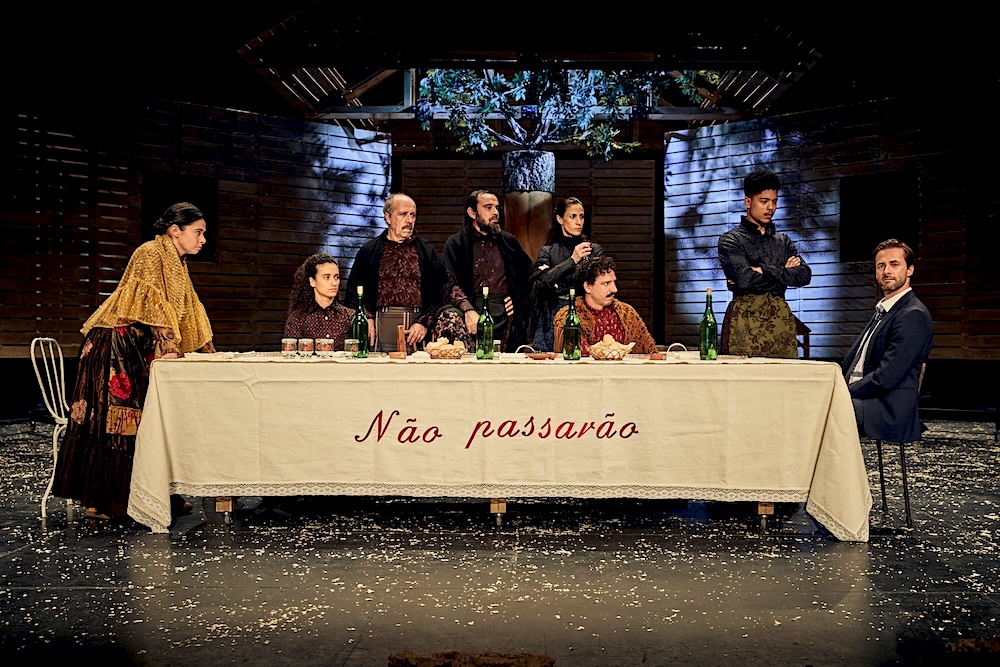
The plot, as indicated by the title, is a blend of leftist politics and magic realism. Set on a small country farm near Baleizão, south of Lisbon, it tells the story of a family who gather once a year on the anniversary of the killing of a toxic male by Catarina, their great grandmother some 70 or so years ago. In memory of her, all the family wear women’s clothing and all, regardless of gender, are called Catarina. And, oh, every year they execute a kidnapped fascist. This year it’s the turn of 26-year-old Catarina to shoot her first fascist. This is not difficult: it’s 2028, and a far-right party has won the general election. Having kidnapped an important political speech-writer, what happens if Catarina decides not to kill him?
Rodrigues’s drama is a Brechtian play of ideas and ethical choices. Based the true case of Catarina Eufémia, a striking worker killed in 1954 under the Salazar dictatorship, and taking its emotional fuel from women’s rage at being abused, it explores a whole series of moral arguments about violence, freedom and tolerance. These are familiar questions about whether it’s appropriate to call members of the far-right “fascists”, how to stop their popularity with voters, and, more personally, how you define yourself in relation to the expectations of your family: individual identity against clan thinking. This culminates in a terrific argument between young Catarina and her mother about the ethics of killing their captured fascist. It’s a compelling highpoint.
The play is also a magical realist evocation of country living, a kind of wild mix of Gabriel García Márquez and Paula Rego. Rodrigues’s text is sown with metaphors, which sprout, grow and blossom all over the speeches of the characters. There’s a lot about blood and heritage, about food as a bond (one of the young Catarinas is a vegan among pigs-trotter-eaters), about swallows if not amazons. “In every woman lives a rebel” is a constant refrain. Early on, the metaphor of fire, which is easy to light, but uncontrollable, suggests that killing your enemy, however beautiful an act, might not be such a good idea. In this metaphor-heavy event, I can’t resist reaching for my own simile to describe the experience of the play: it’s like having your head punched. And punched repeatedly. Bang. Bang. Bang.
Early on, I just knew this would be headbanging night. The show’s website and programme give the running time as two and a half hours without an interval. Bang.
Repeated mentions of Brecht, and quotations from his work, warn me that this will be a didactic event: lots of repetition; lots of finger-wagging; a preacher’s bonanza. Bang.
And the play’s ending, which is a 25-minute speech by the fascist, is almost unendurable. Deliberately so. Bang. Bang. Bang.
Rodrigues first exhausts the audience by the sheer length of the play, and its constant shifts in argument as the family seeks to persuade young Catarina to do the beautiful killing, then hammers home his point that far-right ideology is revolting. It’s very effective, but also very crude. And kind of pointless. I mean, do we need to be lectured about the evils of the far-right? Who changes their mind after being punched in the head? Bang.
This experience reminded me of another metaphor — George Orwell’s vision of the dystopian future in 1984: “If you want a picture of the future, imagine a boot stamping on a human face — for ever.” Bang.
There’s been a lot of publicity about the play, which premiered at Centro Cultural Vila Flor in Guimarães, northern Portugal, in 2020 and has toured a lot since, being a most offensive show. In other countries the ending has provoked walk outs, noisy protests and even a stage invasion. In London, the audience on the press night were glum but mainly silent. Apart from the odd groan, whistle and a couple of walkouts, people just endured the vileness of fascist rhetoric without being tempted to intervene. Not rising to the bait. It’s all rather English, isn’t it?
Still, Rodrigues, artistic director of the Avignon fest, is successful at exploring what he calls “the paradox of tolerance”, putting up with people and ideas that wouldn’t put up with you. Tolerating the intolerant. I was reminded at some moments of Ariel Dorfman’s Death and the Maiden, another play which asks what to do with an abducted fascist. Not only is Rodrigues’s play full of clashing arguments, it is also passionate in its revulsion from violence against women. At the same time, you cannot deny its heavy-handedness.
Still, Rodrigues directs with a sure hand. At first the cast is very still, as if posing for a family photograph, a moment which suddenly morphs into seated Fado dance moves, and then the play opens out. Its central dilemma, a typically Brechtian “what would you do?” about a speeding train and choosing whether to direct it against one close relative or a crowd of strangers is clearly and beautifully staged. The cast is excellent, and includes Isabel Abreu and Beatriz Maia as mother and daughter, António Parra, António Fonseca and Marco Mendonça, with Romeu Costa as the fascist. Designers F Ribeiro and José António Tenente create an environment of surreal strangeness. An example of unforgettable theatre that delivers mixed results. With a bang.
This review first appeared on The Arts Desk