Holy Fool, Park Theatre

Friday 4th September 2026
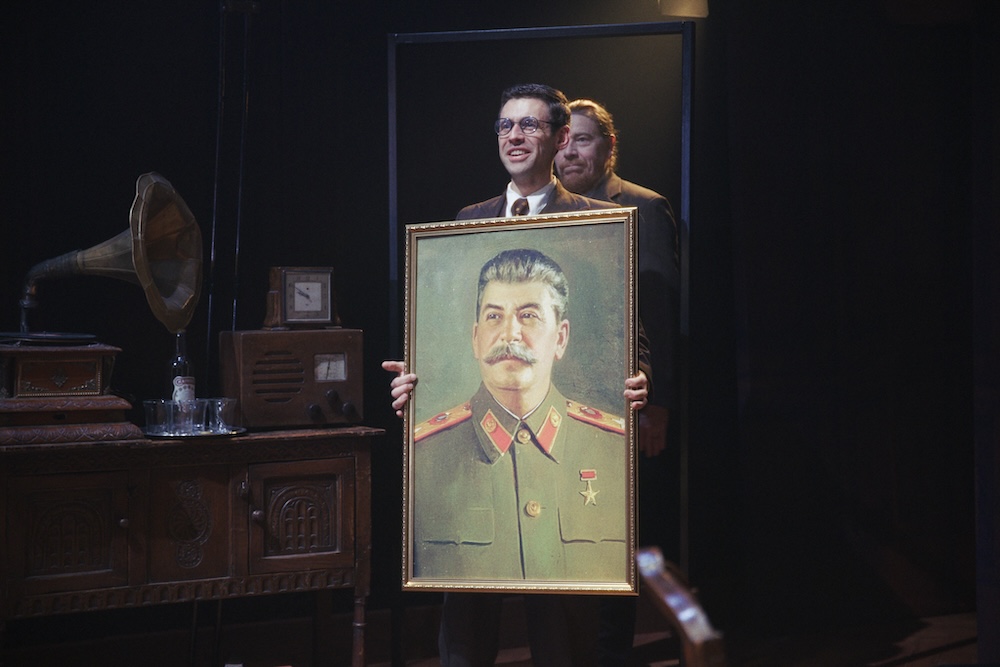
Benjamin O’Mahony and Fergus O’Donnell in Holy Fool. Photo: Mark Douet
Click Image to Enlarge

Okay, it’s a very familiar problem: how do you create drama out of an artist’s life? Most great artists — writers, painters or composers — spend most of their time, practically and mentally, doing their work. And in most cases this is impossible to stage; much of the process is internal, and the result is more interesting than the creative labour. So you’re left with mundane biography. Luckily, the life of Soviet composer Dmitri Shostakovich, the holy fool of Rosalind Adler and Lea Sellers’s new play, is full of incident. Yet the challenge remains: how do you dramatize it?

Holy Fool begins in 1936, when Shostakovich’s modernist opera Lady Macbeth of Mtsensk is condemned by Pravda as “Muddle instead of music” after Stalin finds it offensive to his ears. In this period of the Great Terror, any artist who fails to adopt the state-sponsored aesthetics of Social Realism faces cancellation, often death. By chance, Shostakovich survives, and is rehabilitated in November 1937 with the triumphant premiere of his Symphony No 5. Subtitled “A Soviet artist’s creative reply to just criticism” by a journalist, the work was a success with both Soviet officials and audiences.

Then, in 1941, we find Mitya, as his family calls him, suffering starvation during the siege of Leningrad by the Germans, along with his wife Nina, a physicist and critic of the regime whose career is secondary to that of her husband. Here he writes another successful symphony, No 7, the “Leningrad”, which he dedicates to his home city and resistance against fascism. But he is still unable to publish his fourth symphony for fear of official censure, and the manuscript remains hidden in his flat. After the war he visits New York, but is unable to do more than mouth official Soviet clichés. After some more scenes, he finally visits the States again in 1973.

These biographical details are familiar, as is the story of the composer sleeping on the landing of his housing block next to a packed suitcase so that if the KGB came to arrest him they wouldn’t disturb his children. The trouble is that this staging of decades of a life as a play is pedestrian at best, and at worst frankly irritating. Adler and Sellers give us lots of short and rather unsatisfyingly superficial scenes, in which the main theme is the life of the artist under an oppressive regime, and the main amusement comes from the sarcastic comments of Mitya’s wife Nina. Even the wonderful blasts of some of his best music can’t compensate for the plodding nature of the storytelling.

Then, just as I’m about to give up on this play, the writers do something that wakes me up. Earlier in the first act, they introduce the fictional character of Katya, a young Soviet fanatic, whose head Mitya fills with dreams of becoming a musician. Then, late in act two, Katya reappears, this time to confront the composer with his bad faith: he advised her not to join the Communist Party, but joined himself and has often supported the regime, and been rewarded for doing so. Katya, meanwhile, has become a plumber, like her father. Her life has been harder than his: he is privileged, she struggles. But if this moment of dramatic conflict lights up the stage, it also suggests a better, more imaginatively original, play than the one it occurs in.

Yet despite the limitations of Holy Fool, and the programme’s heavy-handed attempts to draw parallels between Stalin and Putin, the life of Shostakovich does suggest ideas about the tensions between individual creativity and the demands of power. Although he was not a dissident, the composer’s passion for his own work did put him in danger. His insistence that his art belongs to himself clashes with the edicts of the censorious dictatorship. But maybe, just maybe, it was the pressure of these very tensions that inspired so much of his best work, whether it encoded protest or pushed the boundaries of symphonic composition.

Sadly, director Kate Fahy and designer William Fricker’s production is unable to overcome some of the drawbacks of the clumsy playwriting, although the cast do well with the material they have. Benjamin O’Mahony’s Mitya has the convincing attitude of distraction to daily cares which we expect from a creative genius, and Jenna Augen’s Nina does very well to bring him down to earth with some the best biting lines of the play. Likewise, Phoebe Pryce’s Katya connects well with her character’s powerful emotions, especially when she argues for the publication of Symphony No 4. They are ably supported by Fergus O’Donnell, who plays several subsidiary parts, as does Pryce. But the overall effect of the production is rather incoherent and incomplete.

This review first appeared on The Theatre Times
1 Comment

  • John Motadel commented

    on Tuesday 6th October 2026 at 6:27 pm

    Thanks for your excellent review! Here's my take! Holy Fool at the Park Theatre: History Overwritten for a Convenient Fable As drama, Holy Fool is disappointing; as history, it is riddled with errors and misrepresentations. Well before the interval, I found myself hoping it would end soon. It did not. The characters are thinly drawn and scarcely develop. The two principal women, in particular, spend much of the evening shouting rather than acquiring greater depth. Shostakovich himself is rendered as timid and dependent, practically and morally, on two women: his wife and a young woman who becomes a plumber. This is a strangely simplified portrait of a man whose actual predicament was far more interesting. Shostakovich was frightened - he had every reason to be - but he was also politically shrewd, calculating, and acutely conscious of what every public action might cost him and those around him. He held positions within the Soviet musical establishment, joined the Communist Party in 1960, and allowed his name to appear beneath public statements he almost certainly had not written. The fascinating question is not whether he was a coward or a hero, but how an artist survived, compromised, resisted, accommodated, and continued to create under a murderous dictatorship. The invented plumber At the center of the play is a fictitious and extraordinarily articulate female plumber who persuades Shostakovich to find the courage to have his Fourth Symphony performed. We are told that its score has been hidden beneath his floorboards for decades. The actual history is considerably more interesting. The Fourth Symphony was withdrawn during rehearsals in December 1936, only months after the notorious Pravda attack on Lady Macbeth of Mtsensk. The once-common suggestion that Shostakovich simply lost confidence in the work is difficult to reconcile with the evidence. Pressure appears to have come from the Leningrad authorities, and the Philharmonic's director, Isaï Renzin, persuaded Shostakovich to withdraw the symphony rather than expose the institution, its musicians, and the composer himself to potentially disastrous consequences. The work then disappeared from public performance for twenty-five years. The composer's manuscript score was lost during the war, but the surviving orchestral material eventually made reconstruction possible. The symphony was finally premiered in 1961 under Kirill Kondrashin, during the changed political climate following Stalin's death. There was no hidden score beneath the floorboards and no inspirational plumber required to give Shostakovich courage. Yet in the final scene, an aged Shostakovich - whose hair has remarkably remained as dark as ever - presents the original score to the former plumber, who has meanwhile emigrated to the United States and made a fortune. It is a neat theatrical resolution. It is also historical fantasy. More importantly, it is unnecessary fantasy. The real story - a symphony withdrawn under political pressure, silenced for a quarter-century, its manuscript lost, the work reconstructed from surviving material and finally heard in 1961 - is surely more dramatic than the story the playwrights have substituted for it. More history rewritten The play also suggests that Shostakovich, supported by a wife whom he was thereby endangering along with their children, remained in Leningrad so that he could conduct his Seventh Symphony as a morale-boosting gesture. He did not. Shostakovich and his family were evacuated from Leningrad in October 1941. The Seventh Symphony received its premiere in Kuibyshev in March 1942 under Samuil Samosud. Its legendary Leningrad performance five months later was conducted by Karl Eliasberg, leading an orchestra of desperately weakened and half-starved musicians. Shostakovich conducted neither performance. Curiously, the play's treatment of the war also gives little sense of something indispensable to understanding its Soviet characters: whatever the monstrous nature of Stalin's regime, the Soviet Union bore an extraordinary share of the struggle and sacrifice that defeated Nazi Germany. That reality formed the world in which these people lived. Even the title is questionable. The traditional “holy fool” possesses a peculiar licence to speak truths that others cannot. Shostakovich generally possessed no such licence. What he possessed instead was ambiguity. If dissent existed, it could inhabit irony, quotation, grotesquerie and musical double meanings in ways that his public speech could not. That is a much more interesting dramatic problem. Dramatic licence - and presentism The animating concern of the playwrights and director appears to be the historical neglect of women's lives and labour, hence the invention of the plumber as Shostakovich's moral and intellectual catalyst. That is an entirely legitimate subject for drama. It does not, however, justify rewriting someone else's life to accommodate it. Historical drama necessarily invents. We do not know what historical figures said to one another in private rooms, how they looked at one another, what silences occurred between sentences, or precisely what they thought at moments of crisis. Drama earns its keep by imagining those things. But there is an important distinction between imagining what the historical record cannot tell us and contradicting what it does tell us. Invented dialogue can illuminate history. Composite characters can sometimes clarify it. Imagined scenes can explore the pressure, fear, ambiguity and moral cost concealed behind documented events. But when invention changes the known events themselves simply because another story better suits the dramatist's contemporary purposes, historical drama becomes historical appropriation. That is what happens here. The true history of the Fourth Symphony - withdrawn in rehearsal at the height of Shostakovich's vulnerability, silenced for twenty-five years, its manuscript lost, the work reconstructed and finally premiered in 1961 - is richer, stranger and more ambiguous than anything involving a score beneath the floorboards. The play's inventions are therefore not merely historically false. They are dramatically weaker than the truth. There is also an uncomfortable irony. Throughout his life, Shostakovich was repeatedly required to mean what other people needed him to mean. The Soviet state appropriated his music and public persona for its purposes. Admirers and opponents have subsequently fought over him as secret dissident, compromised apparatchik, frightened survivor or coded political commentator. Holy Fool does something uncomfortably similar. It conscripts him into a contemporary story about women's unrecognized labor and agency. In doing so, it risks precisely the presentism historical drama should resist: allowing the preoccupations of our own moment to overwrite the complexities of another. Why it matters This matters particularly with Shostakovich because many members of the audience will understandably know little of the history and may leave the theater assuming that what they have seen is substantially true. There is no shortage of material from which to construct a more convincing Shostakovich. There are excellent biographies and memoirs, and Julian Barnes's novel The Noise of Time, whatever liberties fiction inevitably takes, demonstrates how intelligently Shostakovich's fear, compromise and moral ambiguity can be dramatized. The tragedy is that Holy Fool did not need to falsify its subject in order to make him theatrically interesting. The real Shostakovich - brilliant, frightened, calculating, compromised, courageous at some moments and compliant at others - is vastly more compelling than the passive figure presented here. Nor did the playwrights need to diminish Shostakovich in order to write about forgotten women. There are countless real women whose lives under Stalinism would provide precisely that story. Instead, Holy Fool takes an extraordinarily complex man living through extraordinarily complex times and simplifies both to produce a contemporary moral fable. Shostakovich deserved better. So does the audience. Rating: ★ John Motadel

Leave a Comment!

Fields marked with * are mandatory

Join my email club

I'll let you know by email whenever I add new content to the site: