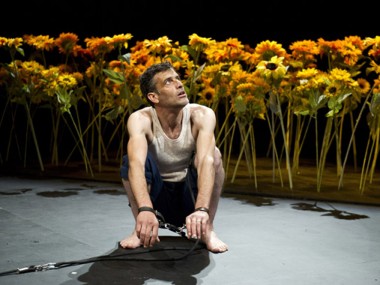
Dogstar, Hampstead Theatre
Monday 9th November 2026

It’s all about freedom of movement. Eh? Of course, I don’t mean our relationship with Europe, but rather the way that playwrights trap their characters in a story with no escape. Once these fictional personages are placed in such extreme situations there’s a problem: what can they do to break this drama-draining stasis? A case in point is Theresa Ikoko’s hostage play, Girls, currently being revived at the Young Vic. Another is Daisy Hall’s new play, Dogstar, at the Hampstead Theatre’s studio space, in which the characters are trapped on an icebound whaling ship with no hope of rescue. They cannot move, so is the story likewise frozen in stasis?
Most of the crew of the Dogstar, a mid-Victorian whaler trapped in Arctic ice, have already died. It’s freezing cold, and lack of fresh food has meant that the five survivors are suffering from scurvy. One of them, John, is dying in his berth; another, the Captain, is drunk inside his cabin and has locked the door. That leaves three to manage the situation: Babben, the oldest and most experienced harpooner, Gorey, a seaman in his 30s, and the teenage Sam, who’s new to the job. It is the youngster Sam who seems to have cursed the crew by, in an incident reminiscent of The Rime of the Ancient Mariner, killing a creature that brings bad luck. Since all of them are trapped on the boat, what can they do next?
The answer to this lack of free movement, this static situation, is firstly to talk, talk, talk. In a play that’s mainly a study in character, the three men are sharply distinguished: like refugees from a Victorian Waiting for Godot, the spiky Gorey and the naïve Sam banter and get on each other’s nerves. Sam is anxious to please and feels most secure when he can stick to the rules, while Gorey is more mutinous and overtly critical of the Captain’s fatal decisions, which have more than a salty whiff of Moby Dick and Lord Jim. By contrast, Babben is an injured giant, a man who once dominated the other whalers, even as he rejects the absurd idea that he has harpooned a thousand beasts, and now tries to keep the peace on board. His dream? To retire and spend time with his wife and sons.
Hall’s writing is psychologically realistic and emotionally sensitive: her characters are not particularly attractive or charming, and they don’t really like each other. They’re at work and they are trapped together. They have to rub along. This humane insight is developed along with some darkly humorous jokes and eccentric ethical discussions: ranging, for example, from When is it okay to steal pears? to How do we get into heaven? The mixture of fun and the macabre gives the dilemmas about self-sacrifice and loyalty to fellow crew members a tough reality in this representation of a situation in which there is no way out. For its 85 minutes of running time this static reality already seems too long.
Faced with the problem of what to do next, Hall chooses two solutions: kill off the characters, and employ some magic. From the start, the offstage John is dying so his demise is no surprise, but who else can the playwright eliminate? Since Gorey has managed to hold onto a gun, despite the Captain’s confiscation of onboard weaponry, there’s a tingle of danger in the situation. But the most dramatic solution to the stasis on the Dogstar is magic: every person that dies summons the figure of Carmichael, the ship’s owner, who leaves evidence of his existence — a gold watch, a silk dressing gown — and a promise of salvation.
Of course, the situation is ambivalent: are Babben, Gorey and Sam suffering hallucinations provoked by scurvy, or by the Northern Lights, or by cabin fever? Or is there really a supernatural force at work? And what does this say about the mixture of pessimism and optimism that each of us typically experiences in situations where there seems to be no easy exit? I have to say that although I admire the ruffled, ragged and rugged quality of Hall’s dialogues, her insights into the crew’s various aspirations and dreams, I’m not much gripped by the magic realism of the play. This kind of imaginative writing doesn’t feel very dramatic to me — the stakes seem rather low.
Still, the wider resonances of story are interesting, if also lacking in drama. The crew’s realization that they have hunted whales to the point of extinction, and that the destruction of this particular ship is an example of poetic justice, clearly has an echo in our present era of declining biodiversity and habitat devastation. The poverty of work available for the poorer folk of seaside communities likewise finds a counterpart in contemporary anxieties about unemployment. It’s sobering to think that our own teenage Sams face a similar lack of choice when it comes to earning a living, while Babben’s warm memories of his family home are more than the nostalgia of the seafarer for his port.
But, by putting the characters in a trapped situation, Hall subliminally suggests that there is no resolution of ecological dilemmas, and that only magic can save humanity. Be that as it may, Lucy Morrison’s production is very watchable: it has an appropriately claustrophobic design by Hannah Schmidt, with Anna Short’s sound design of cracking ice and ominous rumbles providing a ghostly background. The acting is excellent: Adam Rojko Vega’s lively and provocative Gorey contrasts well with Abdul Jalloh’s more cautious Sam, while Justin Edwards’s Babben has an impressively physical and moral power. If you can forgive the static quality of the plotting, then this is an enjoyably ghostly excursion on a cold winter evening.
This review first appeared on The Arts Desk
- Dogstar is at the Hampstead Theatre until 5 December.