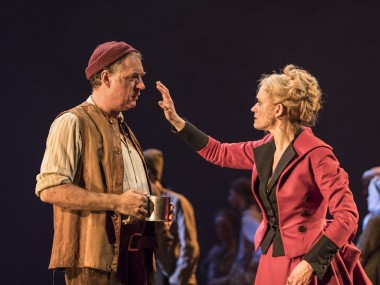
Cloud 9, National Theatre
Saturday 14th November 2026
For years I’ve been saying that Caryl Churchill is our greatest living playwright — and now everyone else is saying the same thing! Her best known plays include Light Shining in Buckinghamshire, Top Girls and Far Away. And Cloud 9, which was first staged by Joint Stock theatre company in 1979, and is now being revived, perhaps long overdue, at the National Theatre, by Dominic Cooke.
Churchill’s greatness is based on her astonishing ability to innovate both in form and in content. So Cloud 9 is a play that discusses gender and sexuality, but in an indirect and provocative way. Act One is set in British colonial Africa in 1879, and examines a patriarchal Victorian family whose confident assertions of gender and racial superiority are mocked by means of a satirical farce. Act Two is set 100 years later, but the same characters have only aged 25 years.
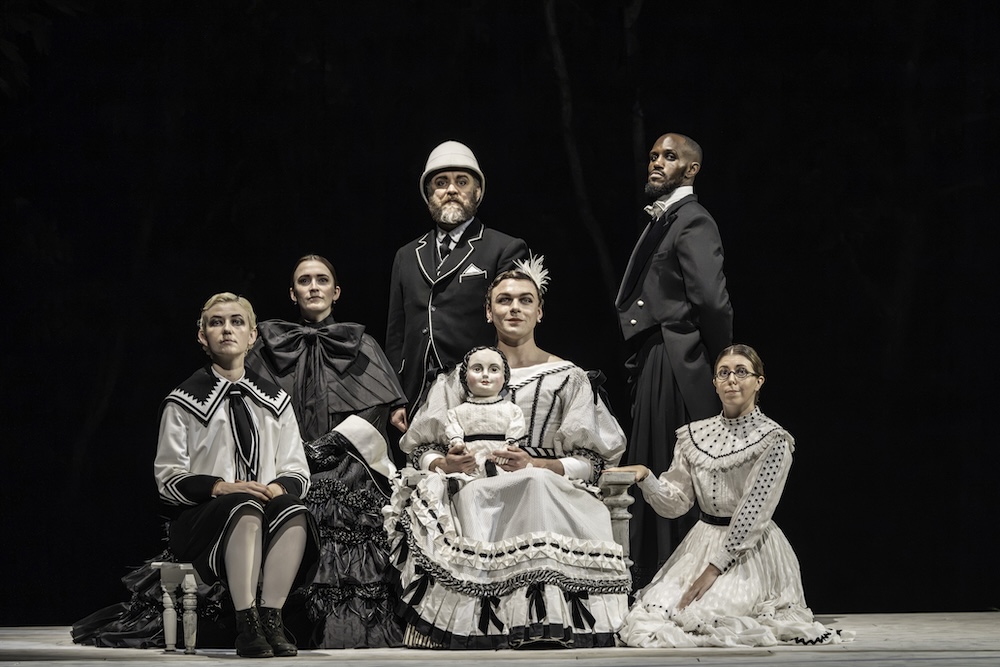
This daringly imaginative form enables Churchill to compare the old-fashioned if long-lasting attitudes to women and sex with the newer more liberated ideas of behaviour of the 1970s through the lives of a set of characters, many of whom are played by actors of a different sex. These include the Victorian family of patriarch Clive, a colonial administrator, his wife Betty (played by a man), their son Edward (played by a woman), their daughter Victoria (a doll), plus Betty’s mother Maud, Edward’s governess Ellen, their servant Joshua and family friends Mrs Saunders, a widow, and Harry, an explorer.
In the 1970s, sexual liberation is in the air, and Betty and her son Edward are now played by a woman and a man, and her daughter Victoria, no longer a doll, is married to Martin. Edward has a lover, Gerry, while Lin, a single mother they meet in a local park, has a very young daughter Cathy (played by a man). As well as Edward and Gerry, Lin is also gay, and attracted to Victoria. The crosscurrents of sexuality, once repressed and now overt, include Gerry’s erotic adventures with random men. Likewise, Betty, Edward and Victoria are loosening up, and Martin is learning to accept the new sensibility that is second wave feminism. At the same time, Britain’s failing colonialism is represented by Lin’s offstage brother, who serves as a soldier in Northern Ireland.
In Act One, the rigid structure of the play reflects the imperialist domination of black people and is mirrored by the male domination of women. Although this is put into question by Betty’s attraction to Harry, and by Harry’s barely repressed feelings for Clive and for Edward. It’s not going to be easy to marry him off to Mrs Saunders or Ellen. Meanwhile, Joshua the black servant, is plotting his own revenge. By Act Two, the looser structure suggests that the energy of life comes more from women and gay people than from traditional heterosexuals. Change is all around: Betty especially discovers more about herself and her sexuality, culminating in a classic speech about masturbation, while everyone else joins in orgiastic sex.
Although the tone of the play is joyous, and even childcare is shown as fun, Churchill argues the serious point that sexual desire is fluid and irrepressible. Clive fancies Mrs Saunders, Harry has sex with Joshua and Edward, as well as kissing Betty, and Ellen is in love with a woman. A hundred years later, the situation is the same: Joshua has sex with dozens of men, Lin fancies Victoria, and Edward shares a bed with both women. What’s changed? According to Churchill, the hypocrisy of the Victorian era has been replaced by the openness of 1970s counterculture. But, perhaps more importantly, Churchill also shows that each of us, at whatever age, has the capacity to develop our sensibility and attitudes.
Has this led to greater happiness? Not entirely, as Martin finds it difficult to adapt to the new mores, and Victoria questions the expectations of feminist ideology. Still, there’s a lot of idealistic good feeling among the women and the gays. Parents are more sensitive to their children, although at various points of stress, their anger takes a physical form. Cloud 9 remains challenging, perhaps even more so than in the late 1970s, in its casual depiction of a paedophile relationship, its embrace of incest, and the brief humorous flash of necrophilia, as well as a flash of a, well, flasher. Would any playwright dare make the same jokes today?
So while the play is saying that sex is often funny, and that desire is essentially uncontrollable, it is also making lots of other points. In Act One, there is a sexual encounter which satisfies the man, but not the woman, a situation not uncommon before the advent of second wave feminism, and probably often still experienced today. In Act Two, gay relationships are shown to be as varied and fraught as straight ones. And, in both parts, the upbringing of children is linked to adult anxieties about gender: can boys play with dolls, can girls love guns? With the unanswerable question: how much do parents, and family, influence our sexual development?
Watching Cooke’s dazzlingly successful production, the first thing to strike me is its vividly memorable design by Miriam Buether: Act One takes place on a proscenium stage, complete with red plush curtain and massive pillars, with the cast dressed in Samuel Wyer’s magnificently beautiful black and white costumes (which remind me of Cecil Beaton’s 1964 designs for My Fair Lady). A Union Jack hangs limply at the side. In Act Two, after a 30-minute interval, the pillars are shattered, the curtain drapes over the front stalls and audience members sit on stage among the ruins. When it comes to sing the song “Cloud 9”, they join in.
Of course, Cooke is aware of the way that sensibilities have changed over the past quarter century. In defiance of Churchill’s explicit direction that “it is essential for Joshua to be played by a white” (because he has internalized the culture of the colonizers), he is subtly played here by a black actor, Eloka Ivo. This is no big deal and, if anything, increases the sense that, in the words Frantz Fanon’s Black Skin, White Masks, “There is but one destiny for the black man. And it is white.” The irony is obvious. Or, even more provocatively, “The colonized is elevated above his jungle status in proportion to his adoption of the mother country’s cultural standards.” Oppression is psychological as well as physical — the same applies to patriarchy.
Churchill’s examination of gender, the conditioning of our upbringing, is emphasised by double casting as the same actors, all of whom deliver excellent performances, appear in both Acts. Sam Troughton is a suitably pompous Clive and a brilliantly anarchic Cathy, Ellen Robertson is the child Edward and the gloriously older Betty, Stuart Thompson the younger Betty and the grown up Edward, Charlotte Ritchie is Maud and the grown up Victoria, Tom Mothersdale is Harry and Martin, while Rebecca Humphries plays Mrs Saunders, Ellen and, best of all, Lin. Eloka Ivo swaps the colonial Joshua for the freewheeling Gerry. All in all, it’s a terrific revival of a terrific play.
This review first appeared on The Arts Desk
- Cloud 9 is at the National Theatre until 13 January.