The Ghost of White Hart Lane, Underbelly Boulevard Soho
Sunday 2nd August 2026
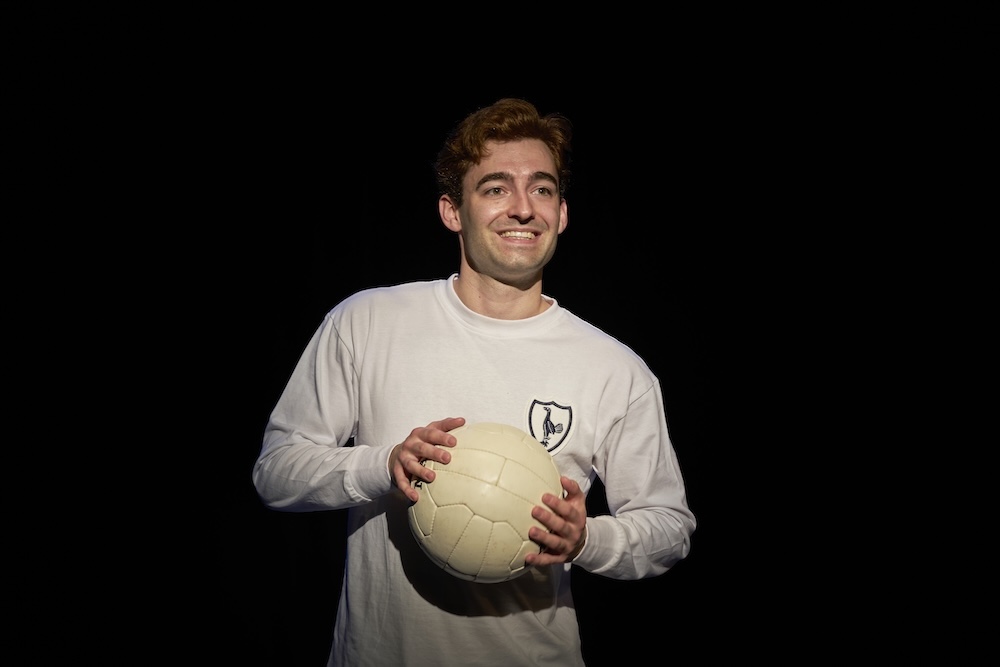
Football, as everybody knows, is much more than a sport: it’s an obsession; it’s an identity; it’s life itself. As such, it’s a world full of stories, of agonies and ecstasies. Martin Murphy’s excellent play, The Ghost of White Hart Lane, tells the story of John White, a Tottenham Hotspur and Scotland star who in 1964 was killed on a golf course by freak lightning, aged 27. This 70-minute one-man show, which was commissioned in 2024 to mark 60 years since his death, premiered at Tottenham Hotspur Stadium in July of that year and then was staged at the Edinburgh Fringe, Musselburgh Festival and Jackson’s Lane in London. I finally catch up with it at the Underbelly Boulevard in Soho, as it moves up to Edinburgh.
Based on the book co-authored by White’s son Rob and Julie Welch, the story takes us from impoverished family life in 1940s Musselburgh, outside Edinburgh, to national and international fame (scoring when Spurs beat Atlético Madrid 5–1 in the 1963 Cup Winners’ Final in Rotterdam). As a club player, John earned the nickname “The Ghost” because of his ability to dribble past defenders and drift into the penalty box, ready to pounce. Playing with a mix of balance, control and constant movement meant that he excelled both at Spurs and in the Scottish national side. The highpoint came in 1961, when he was part of the Spurs team that made history by being the first club in the 20th century to win English football’s Double, claiming both the First Division league title and the FA Cup in the same year. It’s the stuff of legend.
Murphy tells this story, which has its downs as well as ups, with a thrilling command of theatricality. He not only shows White’s life and career, but also alternates this with the experiences of his son Rob, who was just five months old when his dad died. Because of the grief of Sandra, John’s wife and mother of the child, there are no photos of the footballing legend in the house, and his name is rarely mentioned, so the young Rob has to hunt through a box in the attic for information about his lost father. There’s a highly emotional moment when the boy sees the television broadcast of an archive film of his father scoring a goal: “my whole world changes.” There he is, “alive in front of me”, the man in a number 8 shirt who he’d never seen before.
A similarly emotional charge runs through John White’s career as he struggles to overcome the indifference of some managers to his skills because of his light stature, and then has to fight his bouts of depression and insomnia. At one point, his mental health problems threaten his place in the Spurs line up. Oddly, he feels a terrible pain in his back. “Club doctor’s told me it’s psychosomatic, that I should rest, but I can’t rest.” A common double-bind; will this man’s man be able to talk his way to a cure? Maybe, but probably not. Then will the pain disappear by its self? Maybe. These episodes give depth to this portrait of a star player, and make The Ghost of White Hart Lane much more than a story about soccer.
The main theme is the shared search for a rooted sense of identity for both father and son. The Scottish boy who finds his place in professional sport down in London and England, with his charm but vulnerability to depression, and the English boy who exists in a strange world of absence before discovering a love of football on his own terms, and appreciating his father’s life. Murphy also shows how our lives are made up of “ten million different decisions” each of us can make, all with different potential outcomes. Then there’s luck, and bad luck. In White’s case, being struck by lightning was a “ten million to one” chance. Yet it happened.
Although the play is relatively short, it is full of facts and packed with incidents. I like the historic passages about national service, and the moment when White meets Sandra, the daughter of assistant manager Harry Evans and his future wife, when “suddenly life feels right”. There are comic sequences such as when he has to eat a revolting plate of food he can’t refuse, and another when the masculine sportsmen have to do the household chore of washing up. Rob’s own football injury, on the eve of his wedding, is mixed with the fact that he marries on a date that is a day before his father was killed, while the emotion of this coincidence is highlighted when he shows us two rings that his father wore — now fused together by the lightning strike.
Beautifully written, and completely engaging, The Ghost of White Hart Lane is superbly performed by Cal Newman, who plays both father and son, as well as all the other characters in this heartfelt monologue about joy, loss and everything in between. Directed by Murphy, and with set and video designs by Matt Powell, Newman is outstanding in his spry agility, peopling the stage with a deft touch which helps us concentrate on the virtuoso storytelling, and its neatly phrased conclusions: you can never bring the past to life, and it’s not a good idea to keep things bottled up inside. Newman is so personable you never want the show to stop. By the end, you don’t have to be a Spurs fan to love this piece; it’s about life events that touch us all.
© Aleks Sierz